
The final week of June 2026 closes out a quarter with several major AI launches, continued regulatory pressure on tech giants, and interesting developments in the job market and hardware space. Here’s the week’s recap.
Amazon Alexa Receives Major AI Upgrade
Amazon launched what it calls the biggest Alexa update since the assistant’s introduction. The new Alexa is powered by a large language model that Amazon developed in-house, replacing the previous voice-command-based architecture. The new Alexa can hold multi-turn conversations, answer follow-up questions, and understand context across a session rather than treating each request as isolated.
The update also brings on-device processing for basic commands. Setting timers, controlling smart home devices, and answering simple factual questions now happen without sending data to Amazon’s servers. This addresses a long-standing privacy concern about cloud-dependent smart speakers.
The rollout is happening over several weeks to all Alexa-enabled devices including older Echo hardware where hardware permits. Some features require newer Echo devices with more processing power.
Microsoft Windows 11 Security Update
Microsoft pushed a critical security update for Windows 11 this week addressing three vulnerabilities rated as severe. Two involved privilege escalation in the Windows Print Spooler service, and one affected the Windows DNS Client. All three were discovered by external security researchers and disclosed responsibly to Microsoft before any known active exploitation.
This update is categorized as critical and should install automatically through Windows Update. If you’ve been delaying updates, this is a good reason to run a manual update check now. The vulnerability details will become public after a 30-day disclosure window, at which point exploitation attempts typically increase. Updating before that window closes is the responsible action.
Apple App Store Policy Changes
Apple implemented new App Store policies this week in response to regulatory requirements in the European Union, United Kingdom, and Japan. The changes allow third-party payment processors in some app categories and require Apple to allow linking to external purchase options for digital goods. The Digital Markets Act in the EU has driven the most significant changes.
Developers who previously paid Apple’s 15-30% commission on in-app purchases can now direct European users to alternative payment methods. Apple charges a 3% “core technology fee” on transactions that go through alternative payment providers, which has drawn criticism from developers who argue it’s insufficient to cover Apple’s historical cut.
The practical impact for consumers: some apps may show lower prices in the EU as developers pass through savings from lower payment processor fees. Changes in other regions are more limited and dependent on future regulatory actions.
Tech Job Market: Q2 2026 Update
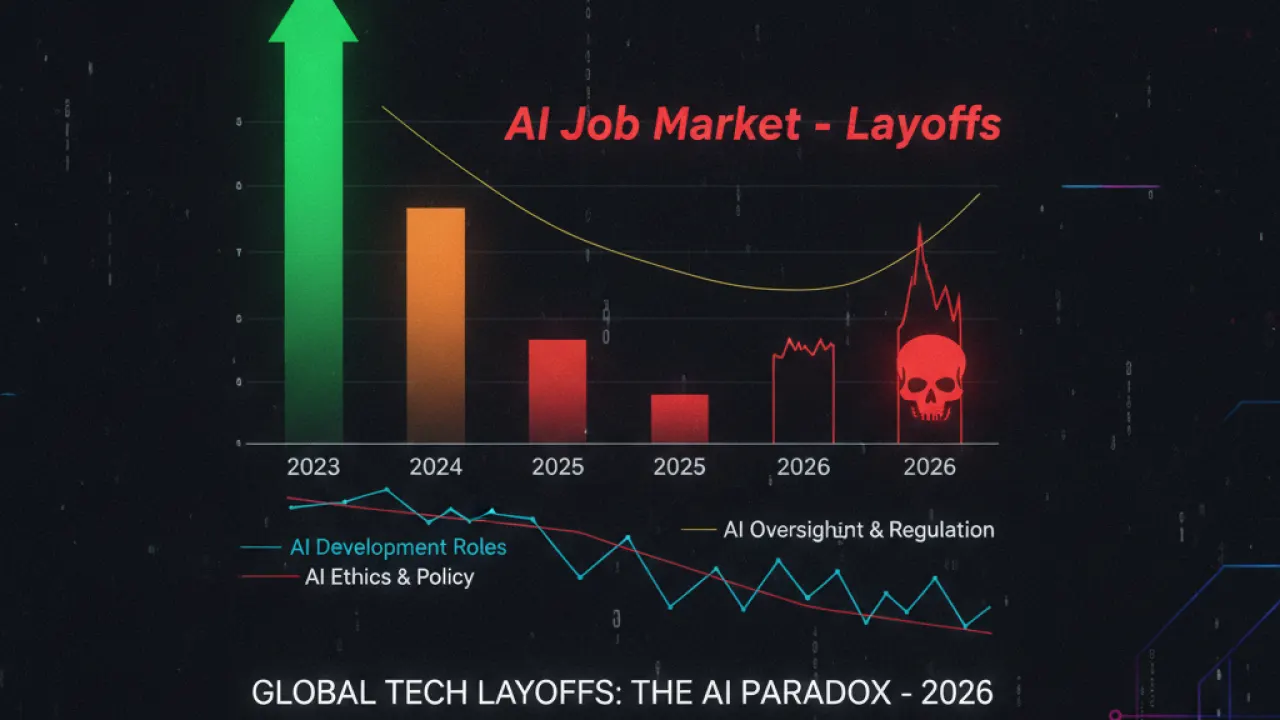
Q2 2026 employment data shows the tech job market in a complex state. Software engineer roles are down 18% compared to Q2 2025, with the reduction concentrated in larger companies. At the same time, AI infrastructure roles, AI safety engineering, and “AI operations” roles (managing AI deployments in enterprise settings) are up significantly.
Data from LinkedIn shows that job listings requiring “AI experience” or “machine learning” have grown 340% compared to Q2 2024. The challenge for existing developers is that these roles often require experience that the current workforce hasn’t had time to develop. Companies are hiring people with 3+ years of LLM-related experience in a field that barely existed 4 years ago.
The overall employment picture varies dramatically by specialty. Frontend developers are seeing the most pressure from AI tools. Database administrators are showing resilience. Cloud and security professionals remain in high demand. For career planning purposes, specializing in AI deployment, security, and cloud infrastructure is where demand exceeds supply most significantly.
Q2 2026 Tech Recap: The Quarter in Review
Looking back at the full quarter ending today:
- Anthropic launched and then globally suspended Claude Fable 5 due to US export controls — the first government-mandated AI model takedown.
- OpenAI GPT-5.5 Instant claimed a 52.5% reduction in hallucinations, a significant quality improvement claim.
- Meta began restructuring around AI, cutting 8,000 jobs while adding 7,000 to AI teams.
- The EU AI Act hit its first compliance deadlines, with real enforcement beginning to materialize.
- Matter 1.3 became the dominant smart home standard, simplifying device interoperability.
- CES 2026 previewed Samsung AI glasses and non-invasive glucose monitoring heading to market.
- Data center power constraints emerged as the most underreported constraint on AI infrastructure growth.
Stay current with the latest AI news roundup every week. And if any of this quarter’s developments prompted you to review your own security setup, our guide to basic cybersecurity tips is the starting point that matters most.
What was the most significant tech development of Q2 2026 in your opinion? Leave a comment with the story you’ll be watching most closely in Q3.