

The first days of July 2026 brought model reliability updates, continued regulatory movement, enterprise deployment case studies with real numbers, and interesting neuroscience-AI research. Here’s the full digest.
Model Updates: Reliability and Consistency
This week saw reliability-focused updates rather than capability announcements from the major labs. OpenAI pushed improvements to ChatGPT’s handling of ambiguous instructions — the model now asks clarifying questions in more situations where the intended task is unclear rather than attempting to complete a potentially wrong interpretation. Anthropic published a technical blog post on how they measure and improve Claude’s consistency across similar prompts, a known challenge for all frontier models.
Google rolled out Gemini 2.5 Pro to more regional markets this week, making the 1M token context window available to enterprise customers in 18 additional countries. The extended regional availability matters for compliance — some enterprises require that data processing occur within specific geographic boundaries, and expanding Gemini’s regional infrastructure addresses this.
AI Regulation: Week’s Developments

The UK government published updated AI safety guidance this week, clarifying what “high-risk” AI systems require third-party auditing under the proposed UK AI framework. The guidance is less prescriptive than the EU AI Act, consistent with the UK’s stated approach of enabling innovation while maintaining safety. The consultation period runs until September 2026.
In the USA, the National Institute of Standards and Technology (NIST) published the second version of its AI Risk Management Framework this week. NIST RMF 2.0 adds guidance on generative AI risks including hallucination, bias amplification, and misuse for disinformation — categories absent from the 2023 original framework that predates the generative AI explosion.
Enterprise Case Studies: Real Productivity Numbers
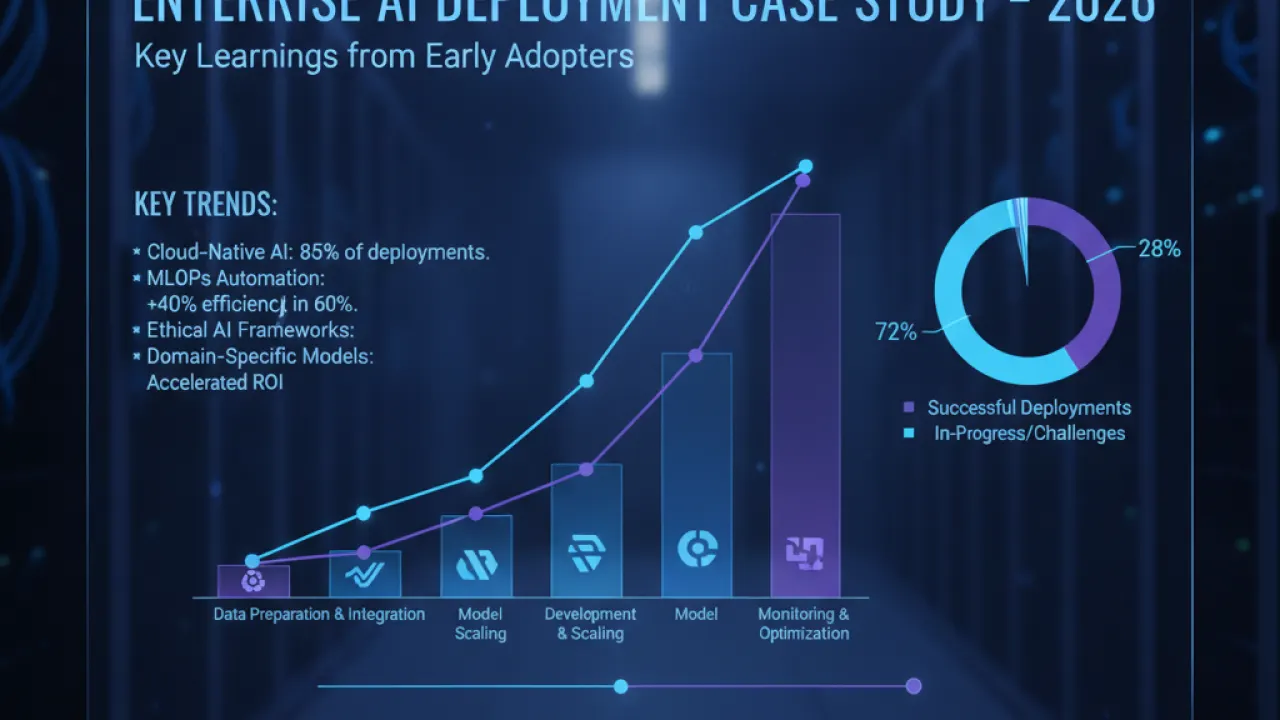
Several enterprise AI deployment case studies published this week provided the quantified productivity data that the industry often talks about but rarely publishes. A global law firm reported a 35% reduction in time spent on initial contract review after deploying an AI-assisted tool that identifies key clauses and flags non-standard language. A healthcare network reported 47% reduction in documentation time for clinical notes using AI transcription and structured note generation.
A manufacturing company published data showing that AI-assisted quality control (computer vision detecting defects on assembly lines) reduced defect escape rates by 23% while the same team inspected 40% more units per shift. These numbers are at the higher end of what independent researchers verify — real deployments often show lower gains due to implementation friction — but the direction is consistent.
Neuroscience-AI Research

A joint paper from DeepMind and University College London published in Nature Neuroscience this week showed that transformer attention mechanisms bear structural similarity to certain prefrontal cortex neural circuits responsible for working memory and attention in primates. The finding doesn’t mean transformers “think like brains,” but it suggests that the mathematical structures that make transformers effective may have biological counterparts that evolution arrived at independently — a convergent solution to similar information processing problems.
The practical implication is limited but intellectually interesting: it suggests that the inductive biases built into transformer architecture may be well-matched to the structure of natural language because both were optimized (by training and evolution respectively) for similar tasks.
New AI Tools Launched This Week

Notable new launches: Linear AI: The project management tool added AI features that auto-write GitHub issue descriptions from code changes, suggest assignees based on past similar issues, and estimate issue complexity from description alone. Figma AI: Figma expanded its AI features to include “Make Design,” which generates complete UI layouts from plain text descriptions with component-level detail. Early demos show promising results for rapid prototyping. Runway Gen-4 Ultra: Runway pushed an update to their video generation model with significantly improved temporal consistency — generated video objects now maintain appearance and physics across longer clips than previous versions.
Stay current with our weekly latest AI news for ongoing AI coverage. And for practical tools you can use today, our best AI tools guide covers the most useful options across every use case.
Which AI development from this week do you think will have the most lasting impact? Leave a comment with your perspective — reader views on which stories matter most are always more interesting than editorial choices.