

The final week of June 2026 brought updates across OpenAI’s developer platform, new research on agentic AI systems, enterprise adoption data, and developments in how governments worldwide are approaching AI regulation. Here’s the complete roundup.
OpenAI Realtime API: Voice Applications Get Easier

OpenAI updated its Realtime API, which enables developers to build voice-based AI applications with real-time transcription and response. The update reduces latency by approximately 40%, bringing response times below the threshold where conversational delays become noticeable to users (under 500ms end-to-end).
New features include speaker diarization (distinguishing between multiple speakers in a conversation), improved background noise filtering, and support for 12 additional languages beyond the original English-only release. The API is priced per audio minute and per token for text processing.
Applications being built on the Realtime API include customer service systems that understand context and can handle complex multi-turn conversations, language learning apps with conversational practice, and accessibility tools for real-time caption generation in specialized formats.
Agentic AI Research: New Findings on Reliability

Three major papers on agentic AI systems published this week on arXiv produced consistent findings: current frontier models complete multi-step agentic tasks correctly about 60-70% of the time on standardized benchmarks. The failure modes are primarily in error recovery (the model fails to detect when a step has gone wrong and continues on a flawed path) and tool selection (the model chooses an inefficient sequence of tools when multiple paths are available).
The research also identified a new class of failure mode called “capability overestimation” — the model proceeds confidently on tasks that are beyond its actual capabilities rather than stopping and reporting uncertainty. This is particularly concerning for autonomous systems where errors can cascade before a human is in the loop to catch them.
The practical takeaway for anyone deploying agentic AI: maintain human oversight for any task where an incorrect outcome has significant consequences. The technology is genuinely useful for lower-stakes automation but not yet reliable enough for critical path automation without human checkpoints.
Enterprise AI Adoption Data
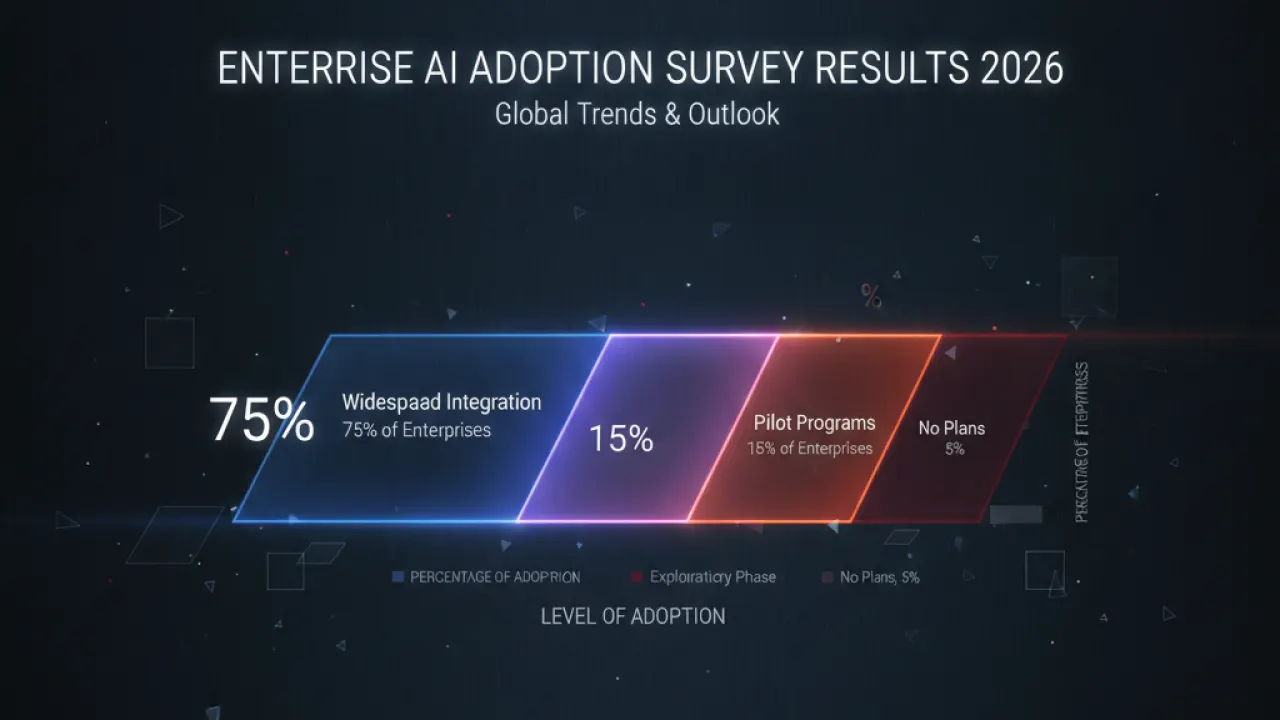
A McKinsey survey published this week showed that 72% of enterprise respondents report using generative AI in at least one business function, up from 33% in 2023. The functions with highest adoption are software engineering (38%), service operations (35%), and marketing and sales (34%).
The survey also tracked where enterprises measure impact. Companies reporting “significant revenue impact” from AI have typically focused on a few high-value use cases done well rather than attempting broad AI deployment across many functions. The “AI washing” effect — companies announcing AI adoption without meaningful implementation — appears to be declining as boards demand demonstrated ROI rather than adoption metrics.
Average cost reduction measured in the successful deployments: 15-25% in the targeted function. Time-to-output reduction in software engineering: 30-40% for tasks like code review, test generation, and documentation.
Global AI Regulation: Convergence Emerging

A comparison of current AI regulation across the EU (AI Act), USA (executive orders and emerging NIST framework), UK (pro-innovation approach), Canada (AIDA), Japan, and Singapore shows meaningful convergence on three core principles: transparency requirements for AI-generated content, mandatory human oversight for high-risk AI decisions, and some form of impact assessment for frontier models.
The divergence is primarily in implementation and enforcement severity. The EU is the strictest with binding regulation and significant fines. The USA relies more heavily on voluntary commitments with the threat of future regulation. The UK has taken the least restrictive approach, positioning itself to attract AI companies wary of EU compliance costs.
For multinational companies, the practical compliance approach is to build to the EU standard — it’s the highest bar and generally meets requirements in other jurisdictions by definition.
Synthetic Data: A Growing Training Strategy

Multiple research groups published results showing that AI models trained partly or entirely on AI-generated synthetic data can match or exceed the performance of models trained on equivalent amounts of real-world data, when the synthetic data generation process is carefully controlled.
This matters for two reasons. First, it offers a path around data privacy concerns — training on synthetic data that statistically resembles real data without containing any actual personal information. Second, it enables training on scenarios that are rare or difficult to collect in the real world (medical emergencies, edge-case driving scenarios, rare language phenomena).
The field is still developing methods to prevent “model collapse” — the degradation that occurs when models are trained repeatedly on AI-generated data without sufficient real-world signal. Current best practice combines synthetic and real data rather than replacing real data entirely.
Stay current with our weekly latest AI news for the full picture of AI developments. And for developers who want to integrate AI into their work, our best AI coding agent guide covers the practical tools available right now.
Which AI development from this week will have the most long-term impact in your view? Leave a comment with the story you think matters most and why.